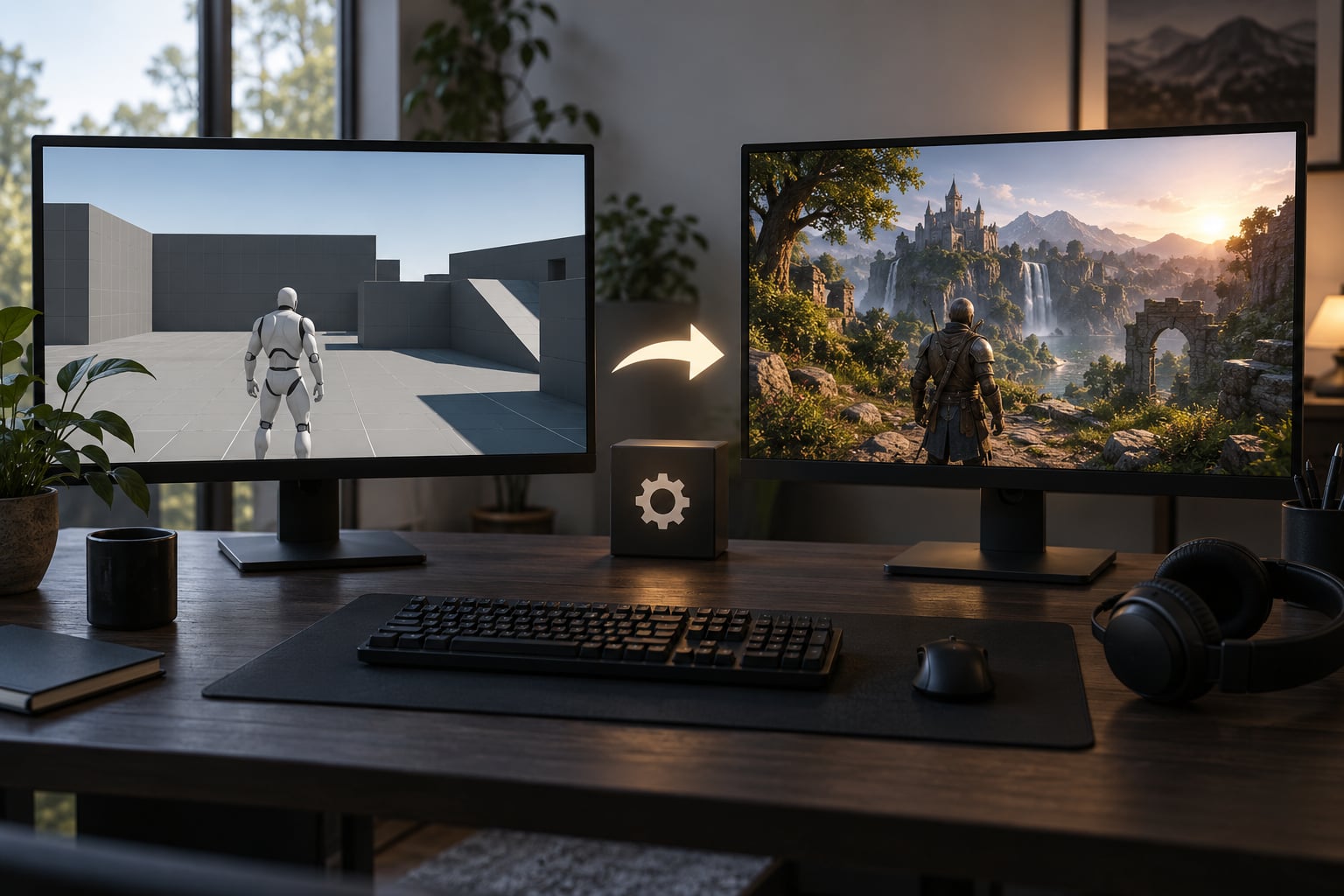
Early access changes a launch by splitting it in two. A developer sells a playable but unfinished version first, takes the money and the feedback, then ships the finished 1.0 release as a second, much bigger commercial event. Everything that follows from that split — pricing, reviews, store visibility, roadmap promises — flows from that mechanic.
Subnautica, Baldur’s Gate 3 and Hades II all came out of it well. Plenty of other games have not, and the difference usually shows up in the patch notes long before it shows up in a review score. Here is what actually changes between the early access launch and release day, and how to read a game that is still in progress.
Table of Contents
- What Early Access Means for a Game Launch
- What early access is not, according to Steamworks
- The terms you will see on the store page
- How Early Access Differs From a Traditional Launch
- What Developers Can Improve Before Release
- Why feedback gets more useful over time
- Why Studios Choose Early Access
- How long should early access last?
- How Early Access Changes the Player Experience
- How to Judge Whether a Game Will Be Ready at Release
- Check the patch notes, not the store page
- Compare the roadmap against the last three releases
- Look for the twelve-month warning
- Read the reviews as a trend, not a score
- Check what is actually finished
- Look at how the studio handles complaints
- Read the Steam Early Access Q&A
- Ask what happens if the studio stops
- What Changes on Release Day
- Frequently Asked Questions
- Does an early access game save carry over to the full release?
- Is early access cheaper than buying the game at full release?
- Does 1.0 mean an early access game is bug-free and complete?
- Can developers change features or remove content during early access?
- Are early access games usually worse than traditional launches?
- How can I tell if an early access game is close to release?
- Conclusion
What Early Access Means for a Game Launch
In Steam’s own words, Early Access lets a developer sell a game while it is still being developed, and labels it clearly as a product that should be considered unfinished. That last clause matters more than it sounds. The badge is not a quality mark or a beta shorthand. It is a legal and commercial statement that the thing you are buying is a work in progress.
The practical version: you buy access now, you keep whatever you have bought if the developer stops work, and you receive free updates for as long as the game is supported. What you do not get is a promise about when it will be finished.
What early access is not, according to Steamworks
Valve’s developer documentation is unusually blunt about this, and the rules are worth knowing because a lot of players get them wrong.
- It is not crowdfunding. You are buying a product that exists and runs, not pledging to a team hoping something ships eventually.
- It is not a pre-order. There is no future purchase. Your money buys the current build and your share of whatever comes after.
- It is not “Advance Access.” Console storefronts use similar-sounding labels for different products. A PlayStation trial or an Xbox preview is a closed test with different rules and usually no money involved.
- It is not a full launch. Early access titles do not receive the full launch visibility that a 1.0 release gets on the store.
That last point catches a lot of people. A game sitting in early access gets its own store page, its own wishlist, its own announcements — but not the front-page carousel push, the launch-week email blast, or the automatic release discount a graduated game receives.
The terms you will see on the store page
Feature complete means the developer considers every planned system present and working, though polish and balance can still continue for months. A 1.0 release is the moment the Early Access badge comes off. Graduation is the same event, named from the developer’s side. Launch visibility is the storefront promotion Valve reserves for released games.
How Early Access Differs From a Traditional Launch
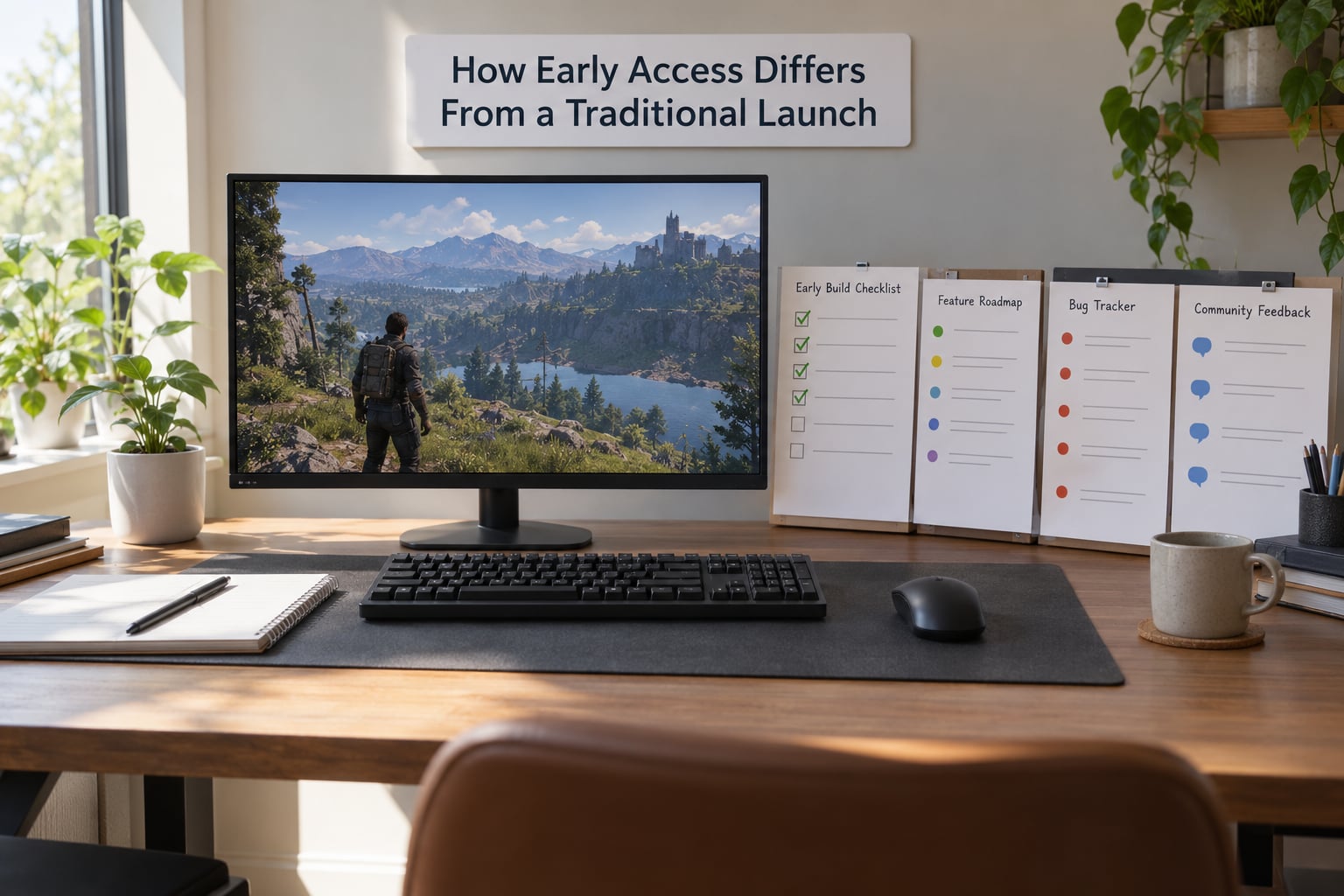
The clearest way to see the difference is to put the two side by side. Nearly every column flips, and the flips compound.
| Factor | Early access launch | Traditional launch |
|---|---|---|
| Release stability | Known rough edges, frequent restarts | Expected to run as intended on day one |
| Available content | A slice of the planned systems | The complete game |
| Cost to the buyer | Set below the eventual release cost | Full release cost, often with a launch discount |
| Developer communication | Roadmap posts, patch notes, Discord, forums | Marketing push, less day-to-day contact |
| Bug expectations | Crashes, save breakage and imbalance are normal | Late bugs read as failures |
| What launch-day reviews mean | Feedback on a build, not a verdict | A lasting verdict on the whole game |
| Store visibility | Limited until the game leaves the program | Full launch promotion |
The review row is the one that gets under-discussed. A game in early access accumulates reviews of a build that is, by design, incomplete. Those scores stay on the page permanently, and both buyers and the press read them as a final assessment. Several developers describe treating the early access review score as noise, which is true commercially and useless in practice.
What Developers Can Improve Before Release
The single most valuable thing early access does is put the game in front of players who have no obligation to be polite about it. That surface area exposes problems a studio’s own testing never will.
Performance comes first, and it is the one most studios underestimate. Frame drops, memory leaks, save corruption and long load times are discovered by thousands of strangers within days, and the pattern of which machines struggle tells the team what to optimise. Controls follow — a comfortable scheme for one person is a chore for everyone else, and only strangers surface that.
Difficulty and progression balance need volume. A boss tuned against internal playtests is tuned against six people. Thousands of hours of stranger data will find the difficulty spike nobody noticed, the weapon that trivialises an encounter, and the quest that quietly softlocks.
Onboarding is the quiet killer. The first hour of a game is designed to explain itself, and a studio watches that first hour over and over until it is muscle memory. Players watch it once. Confusion in the opening twenty minutes is the single most repeated piece of feedback in early access threads.
Content pacing gets tested too, but later and more weakly. A survival-crafting sandbox can be unbalanced for months without anyone noticing because the players who notice are the minority.
Why feedback gets more useful over time
The first month of feedback is loud and mostly wrong. Players are reporting what is broken rather than what is wrong, and the volume is overwhelming. By month six, the same forum threads fill with comparisons, balance spreadsheets and character builds, and the complaints have shifted from “the game crashes” to “this progression curve is boring”.
That transition is the real value. A studio cannot read ten thousand reports in week two, but it can read a curated thread in month nine and find real design signal in it.
Why Studios Choose Early Access
The commercial case is straightforward: revenue arrives before the expensive final stretch of production, when a finished game would otherwise be weeks of polish funded entirely from savings or investors.
Most early access money goes straight back into payroll. It does not sit as a profit pile. That matters for players, because it means the funding is real but it is also entirely consumed — there is rarely a surplus waiting to absorb a crisis six months later.
- Funding. Sales during development pay for the development itself, which is the entire point for most independent studios.
- Market validation. If a thousand people are not playing a free build, a full launch will not save it.
- Audience before launch. Wishlists accumulate early, and wishlists are the single strongest predictor of launch-week sales.
- Content planning. Live data tells a team which factions, biomes, weapons or classes players actually use.
- Server and load testing. Multiplayer backends get stressed by real player numbers instead of simulated ones.
- Marketing runway. A game with a year of patch notes and a Discord full of testers arrives at release with an audience already attached.
How long should early access last?
The trade-off has a measurable cost, and the data is reasonably clear. A 2025 Newzoo report found that games spending four to nine months in early access performed best over their first three months after release, with roughly six months as the sweet spot. A GameDiscoverCo study of more than 1,500 titles found the same tension from the other side: longer early access periods correlate with lower post-launch sales but higher wishlist conversion.
Read together, they say something sensible. Early access past about six months trades launch-week performance for a warmer audience. Two years is a different product decision entirely, and one that frequently looks like the programme is being used as permanent funding.
A developer writing a Reddit postmortem on their own graduation put the economics plainly: first-year sales are typically three to six times first-week sales, so launch week sets the ceiling for the entire year. They estimated about half a first-week sale per pre-launch wishlist, with a range running from 0.14 to 1.8 across their games. Wishlist count, not quality, was the dominant variable in every launch they ran.
How Early Access Changes the Player Experience
Buying in means accepting a different relationship with the game. It is not the same purchase with bugs attached.
You are buying against a roadmap, not against a finished product. Developers publish their plan and then update it, and the plan is a negotiating position rather than a contract. Scope grows. Features get reordered. Entire systems occasionally get removed after testing shows they do not work.
Balance shifts are normal and often severe. A build that was fun last month may be unplayable this month, not because the game got worse but because a designer changed a number in response to feedback. Players who invested time in a strategy find that strategy has been invalidated.
Saves and builds break. Backward compatibility between major versions is rare, and studios that break saves without warning lose the exact audience that opted into the programme. The studios that handle it well announce breaking changes weeks ahead and give migration paths.
Patch rhythm is irregular. There is no launch-week release schedule, no marketing push behind a hotfix, and sometimes months of silence on a game that has no announced end date. Communication quality varies more than anything else about the model — some studios post detailed devlogs, others go quiet for a quarter and return with a roadmap slide.
Players on the forums describe the honest version of the bargain plainly: it is worth it if you enjoy watching development happen and the studio is transparent about what it is doing. The people who buy in hoping for the finished game at the discount cost are the ones who feel cheated.
How to Judge Whether a Game Will Be Ready at Release
You cannot know. But a set of signals separates the games that graduate from the games that quietly die, and most of them are public before you spend anything.
Check the patch notes, not the store page
The store description is marketing written at the start of the programme. The patch notes are a running record of what the team actually did. Games in trouble have patch notes that shrink — a long development history that tapers into monthly maintenance entries. Games in good shape have entries that keep getting longer.
Compare the roadmap against the last three releases
Screenshot the roadmap. Come back in three months and check what shipped. A studio that delivers roughly what it said is trustworthy with its promises. A studio that has rewritten the roadmap twice without acknowledging it is telling you its estimates are fiction.
Look for the twelve-month warning
Steam displays a notice on the store page when a title in early access has not been updated in a long time. It is an objective, platform-level signal that nobody has to argue about. If you see it, you have your answer.
Read the reviews as a trend, not a score
Sort by recent. Early access scores are heavily weighted by the first wave of buyers, who are disproportionately the most critical and the most invested at once. What matters is direction — are reviews mentioning the same unresolved problem six months in? Is the recent sentiment measurably better than the older reviews?
Check what is actually finished
Count the systems on the store page against the systems in the game. One chapter of the promised three, no tutorial, no settings for the new mechanic, no controller remapping on PC — these are not polish gaps, they are unbuilt content wearing a roadmap entry.
Look at how the studio handles complaints
Whether a developer replies to negative reviews and explains a decision tells you more than any roadmap. Silence is the pattern worth watching. So is a studio that responds to every thread but has not shipped a feature in six months — that is a team maintaining an audience rather than building a game.
Read the Steam Early Access Q&A
Every early access title answers a standard set of questions about supported platforms, save locations, refund terms and multiplayer status. Poorly answered questions are a genuine signal. “Multiplayer will be added” repeated across every multiplayer question means the feature is not scoped.
Ask what happens if the studio stops
If a game is abandoned but stays on sale, your purchase is yours and the game stays in your library, frozen. If the title is removed from Steam entirely, Valve may offer refunds for affected purchases. Those are very different outcomes, and the second one is the only real recourse players have.
What Changes on Release Day
Graduation is a launch. That framing surprises players who expect 1.0 to be a quiet moment when a download finishes, but the commercial reality is that removing the Early Access badge triggers the store promotion, the release discount window, and the wishlist notifications that were queued on both sides.
Developers describe the early access launch week and the graduation week as two separate shot windows with two separate sales curves behind them. Some see a spike at graduation that matches or exceeds the early access launch. Others see close to nothing, because their audience already bought and the wishlist conversion was already spent. Which one you get depends almost entirely on how large the pre-launch audience was.
The cost to buyers usually goes up at 1.0, since the discount that justified the unfinished state no longer applies. Launch-day bonuses are common — cosmetics, soundtrack, a separate expansion — and players who bought in early often receive those automatically, which is the main practical reward for being an early supporter.
Reviews at release are frequently mixed, and the split is usually about scope expectations rather than quality. Players who bought in at a discount expected the finished article; players who waited expected something new; the press compares it against the promise in the trailer rather than against the current state of the game.
And graduation does not mean the studio stops. Many games launch 1.0 and continue development for years with the same balance cadence and the same roadmap discipline. The badge comes off, the store page changes, the work continues. Players looking for a finished, unchanging game should read that last sentence carefully.
Frequently Asked Questions
Does an early access game save carry over to the full release?
Usually yes, and studios say so explicitly in their roadmap and store page because breaking saves destroys trust. But there are exceptions: major system rewrites sometimes require a fresh start, and a few projects declare older builds unsupported. The store page and the community hub are where this gets stated. If backward compatibility matters to you, look for the word in the patch notes before you commit hundreds of hours.
Is early access cheaper than buying the game at full release?
In almost every case, yes. Early access games are priced below their eventual release cost, and the cost normally rises when the game graduates to 1.0. That gap is the entire financial argument for buying in, and it is also why so many players deliberately wait — especially for long early access periods, where the savings end up covering several months of updates you could have read for free.
Does 1.0 mean an early access game is bug-free and complete?
No. Feature complete means the planned systems are present, not that they are perfect. Studios routinely ship crashes, balance problems and rough edges at 1.0 and fix them in the weeks after release. Expect an official release to be stable enough to play rather than flawless. If you need a game that is finished in the sense of having no further work planned, early access is the wrong format entirely.
Can developers change features or remove content during early access?
Yes, and they do it more often than players expect. A system can be added, reworked or cut entirely after testing shows it does not work, and the roadmap exists to make those changes legible in advance rather than to prevent them. Roadmaps are explicitly not binding. The most player-friendly studios mark items as tentative and flag changes well ahead of shipping them.
Are early access games usually worse than traditional launches?
It depends entirely on the studio. Early access gives a developer more time with real players, which can produce a more balanced game, but it also stretches development and removes the pressure of a fixed ship date. The pattern worth knowing is that the strongest early access games are systems-driven or sandbox-shaped, where content can grow safely, and the weakest are narrative or mission-driven, where unfinished work is far more visible.
How can I tell if an early access game is close to release?
Look for three things. The roadmap should have most items checked off rather than perpetually rewritten. Patch notes should be shifting from new features to polish, performance and bug fixes. And the store page should show an Early Access Q and A that answers specific questions rather than deferring them. A shrinking backlog of open issues alongside a growing playtest community is the strongest signal that a date has been set internally.
Conclusion
Early access restructures a launch rather than delaying one. The developer gets money and real feedback during the expensive part of production, and the player gets a discounted but genuinely unfinished game with a say in where it goes. Both sides get something, and both sides carry risk the traditional launch does not have.
Before you buy, do four things: read the last three patch notes, screenshot the roadmap and compare it in a few months, check whether the review trend is improving, and look for the store page warning that signals a long absence of updates. Those four checks answer most of the question. If they look healthy, buy in and enjoy watching a game get made.