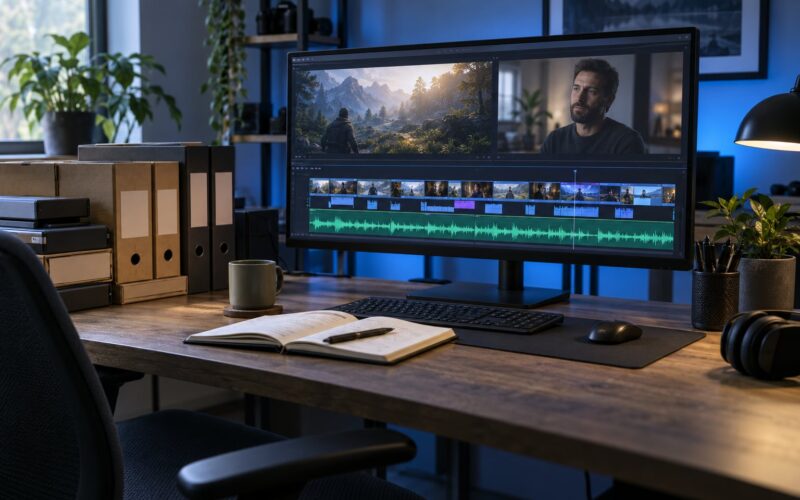
How to research gaming history for a video essay comes down to one thing: building an evidence file before you write a single line of script. You pick one checkable claim, gather dated primary sources around it, log where those sources disagree, and only then outline the beats you can actually support. Most weak gaming essays fail for the same reason: the creator fell in love with a story, found a forum post that agreed with it, and treated that as the record.
The method below takes roughly two to four weeks for a short piece and a good deal longer for a deep dive, and the hard part is almost never finding things. It is deciding what counts as proof.
Table of Contents
- What You Need
- Step-by-Step: How to Research Gaming History for a Video Essay
- 1. Define the Video Essay’s Historical Question
- 2. Build a Reliable Timeline
- 3. Find Primary and Contemporary Sources
- 4. Compare Accounts and Verify Claims
- 5. Use Archival Footage Without Losing Context
- 6. Connect History to a Clear Narrative
- 7. Fact-Check the Script and Assemble the Evidence Log
- Common Mistakes
- Frequently Asked Questions
- How do you start a video essay?
- How to structure a video essay?
- What sources are good for video game history?
- Is it legal to use gameplay footage in a video essay?
- How do you handle conflicting sources in gaming history?
- How do you research a game that was never released?
- Conclusion
What You Need

You need four things before you start, and none of them are expensive. A capture tool so nothing escapes, a source log so you can find a citation ten minutes before publishing, archive access, and a written claim.
A capture tool. Anything that saves a page as a PDF with its date attached. A screenshot alone loses the URL and the capture date, which are exactly the two things a viewer will ask for later.
A source log. A spreadsheet works, and so do Zotero or Obsidian if you already use them. The columns that matter are claim, source, date of the source, what it proves, and where it lives in your timeline. A shared spreadsheet is better if more than one person is researching, because a duplicate source then costs nothing.
Archive access. The Internet Archive and the Wayback Machine are free and hold a surprising amount of dead magazine sites, press releases and storefront pages. GDC Vault hosts free developer talks that go back decades. Patch notes and support pages count as primary sources, and so do contemporary manuals, box art and unboxing footage.
A written claim. One sentence, falsifiable, that your essay will either support or dismantle. “The SNES era was better” is an opinion. “Studio executives publicly tied the controller’s three-button limit to development cost” is a claim you can research.
Here is where gaming history actually lives, and what each source can carry.
| Source type | What it proves | Where to find it | Reliability |
|---|---|---|---|
| Developer interviews and conference talks | Intent, constraints and internal reasoning at the time | GDC Vault, official channels, archived event pages | High, but retrospective interviews drift from memory |
| Contemporary reviews and magazines | How the game was received on release, in a specific region | Internet Archive, periodical scans, retailer PDFs | High for reception, useless for internal facts |
| Manuals, box art, inserts | Features that were advertised, and what was left out | Internet Archive, collector scans, preservation projects | High |
| Patch notes and support pages | What was changed after launch and when | Official news pages, Wayback Machine | Very high, they are dated by definition |
| Press releases and corporate material | What a company wanted the public to believe on a date | Wayback Machine, trade press archives | High for intent, weak for facts |
| Original gameplay capture and demos | What the software actually did, on a named platform and version | Preservation uploads, event captures, demo disc rips | High, once the build is identified |
| Oral histories and museum collections | How workers describe the period from the inside | Museum collections, published oral history projects | Medium to high, memory-based |
| Fan wikis and forums | What the community believes, and where to find leads | Everywhere | Use as a lead only, never as a citation |
One rule keeps this table honest: a source that was created after the fact by someone with a stake in the story is commentary, not evidence. That does not make it useless. It makes it a different category, and your viewers deserve to know which one they are hearing.
Step-by-Step: How to Research Gaming History for a Video Essay
1. Define the Video Essay’s Historical Question
Start by converting your interest into a question with a boundary. Narrow by era, platform, studio, genre, or one decision someone made. A broad question produces a video that lists things; a narrow question produces an argument you can prove.
Write the question down, then write the three things that would prove it. If you cannot list them, you have a topic, not a research project. Topics that survive this test tend to fall into a few shapes: how a genre’s conventions formed, why a launch happened the way it did, what a studio changed after a failure, and how a community read a game its makers did not intend.
It works better to think of the topic as a claim rather than a game. Games are already covered by bigger channels; the specific unanswered question inside one usually is not.
2. Build a Reliable Timeline
Put every dated event you can find on one list before you evaluate any of them. Announcements, release dates, showfloor appearances, patch releases, staff departures, store closures, magazine issues, price changes. Two columns work well: the event and the source that dates it.
Mark each entry as confirmed, probable or disputed, and keep disputed ones on the page rather than deleting them. Disagreement in the record is one of the most interesting things you can put in an essay, and it only reads as interesting if you show the viewer both sides.
A gap in a timeline is information. Six months of silence after a well-publicised announcement usually means something, and finding the reason for the silence is often better material than the announcement itself.
3. Find Primary and Contemporary Sources
Primary sources in gaming history are anything produced by the people involved, at the time. Interviews given that year, magazine reviews published that month, manuals from the original release, patch notes written the week a change shipped, internal memos posted by their own authors.
Secondary sources interpret those primary materials: retrospectives, documentary features, remaster interviews twenty years later, and encyclopaedia entries. Secondary sources are useful for orientation and terrible for dates. A well-written retrospective is still a person remembering, and memory has a shape.
When the two tiers disagree, the primary source wins, and you say on camera that it does. That sentence alone does more for your credibility than an hour of confident narration.
Watch for the sources that look primary but are not. A screenshot of a forum post is a primary source for what a person said, not for what was true. A wiki infobox with no citation is a tertiary source wearing a costume.
4. Compare Accounts and Verify Claims
Every viral gaming fact you find online should be traced before it reaches your script. Take the claim, find the earliest source you can, and ask three things: who said it, when, and what did they have access to at the time?
If the earliest version traces back to a single uncited line in a 2011 forum thread, you have a lead, not a fact. Say so in the video. “This one has been repeated for fifteen years and nobody can find where it started” is a legitimate and genuinely interesting beat, and viewers respond well to it.
For numbers, check what the figure measures and whether anyone else counted. A widely quoted sales total often means one studio’s public estimate recycled through a dozen articles. Attribute it: “according to the publisher’s figures” costs you nothing and protects the whole essay.
When accounts conflict, sort them by date and proximity. Whoever wrote closest to the event with the most direct access usually has the best claim, and later interviews are often shaped by what the studio is currently promoting.
5. Use Archival Footage Without Losing Context
Archival footage only works if the viewer knows what they are looking at. For every clip, record five things in your log: platform, version or region, date, source, and what was happening around it. A clip without those five facts will be misread, usually by your own audience, often within hours.
Captured gameplay from one region can carry different text, different censorship and different frame pacing. Label the region in your edit notes, and say it in the narration when it changes what the footage proves.
Pre-release material needs more care than anything else. Beta builds, demo footage and cancelled content are often labelled with the wrong build number, and a demo presented as final gameplay is a common error in this genre. If you cannot identify the build, present it as a demo and describe it as one.
Credit the people who recorded the material, especially preservation volunteers. A line naming the channel that captured a two-hour 1994 gameplay recording costs you four seconds and buys you a collaboration later.
6. Connect History to a Clear Narrative
Verified facts are not a script. The step that separates an essay from a list is cause and effect: this constraint produced this decision, this decision produced this reception, this reception shaped what came next. Write those connections down as single sentences before you draft any narration.
Organise the timeline into three or four movements rather than a chronological march. Something like an opening that states the puzzle, a middle that follows the pressure building, and a close that shows what the answer costs. Pure chronology usually produces pacing problems, because the interesting parts of most histories are not evenly spaced.
This is where most of the work of how to research gaming history for a video essay happens. The evidence is already in the file by this point, and the difference between a video that holds attention and one that does not is the handful of causal sentences you write next.
Keep one thread running. Readers forgive a slow patch more readily when they know what question is being answered.
7. Fact-Check the Script and Assemble the Evidence Log
Read the draft once for claims only. Every number, date, name and quotation gets matched to a row in your source log, and anything without a row either gets cut or gets hedged properly in the narration. Quoting a person with “around,” “somewhere near,” or “according to” is not weakness, and it is far better than being wrong.
Then decide how you show your work. On-screen citations during the line that makes the claim are the standard most viewers now expect from gaming history channels. A short end-screen list helps, but it does not replace it, because nobody rewinds.
Finally, run the audio and image checks: every clip’s platform and region stated, every music cue licensed or credited, every community source named if it informed the piece. Export, watch it once at full attention, and note the places where you yourself got bored. Those are usually where the argument is missing.
Common Mistakes
Treating nostalgia as evidence. Remembering a game felt groundbreaking proves you were young. Correct it by asking what a contemporary reviewer said, what the manual promised, and what the sales data supports.
Citing fan wikis as a source. They are superb finding aids and terrible citations. Use one to locate the original interview, then cite the interview.
Using modern footage as historical proof. Remastered visuals, current hardware output and re-release trailers cannot demonstrate what a 1996 release looked like. Say “today’s remaster” out loud, or find period capture.
Skipping regional context. A European launch, a Japanese release and a North American release can differ in content and in reception. If you use a single-region source, name the region.
Presenting disputed claims as settled. Put the disagreement on screen with both sources named. Viewers accept uncertainty far more readily than they forgive false certainty.
Burrowing the citations. A source list at the end of a twelve-minute video is decoration. Put the source where the claim is made.
One habit fixes most of these at once: keep the evidence log open next to you while you record the narration. The number of sentences you soften on the fly is usually the number of claims that were never solid.
Frequently Asked Questions
How do you start a video essay?
Start with one checkable claim instead of a whole game or era. Write the question down, then list the three things that would prove it. Gather dated primary sources around that claim, keep a log of where they disagree, and only then outline your beats. Most first drafts stall because the creator starts filming before knowing what evidence supports the ending.
How to structure a video essay?
Give the essay a thesis, a timeline and a shape that is not pure chronology. A workable structure is a cold open that states the puzzle, two or three movements that follow the pressure building, and a close that shows the cost of the answer. Keep one question running through every movement so slow patches still have a purpose.
What sources are good for video game history?
Start with anything created by the people involved at the time: developer interviews and conference talks, contemporary magazine reviews, original manuals and box art, dated patch notes, archived press releases, and captured gameplay you can identify by platform and version. The Internet Archive, the Wayback Machine and GDC Vault cover much of this for free. Fan wikis are useful as leads, not citations.
Is it legal to use gameplay footage in a video essay?
Using short clips of gameplay for criticism, comment or teaching is generally treated as fair use, and courts weigh purpose, how much you take, and what effect it has on the market. Risk rises when you take long uninterrupted passages, replace the original experience, or build your video around play rather than argument. Keep commentary over the footage, keep clips purposeful, and credit creators who recorded it.
How do you handle conflicting sources in gaming history?
Sort accounts by date and proximity to the event, then check what each source had access to when it was written. A dated primary source usually outranks a later interview given during a remaster campaign. If the conflict cannot be resolved, show both on screen with their sources named and tell the viewer why the disagreement matters.
How do you research a game that was never released?
Work from pre-release material and label it as such. Beta footage, demo discs, magazine previews, showfloor captures, pitch documents and developer posts give you the trail. Record the build or demo version for every clip, avoid presenting prototype footage as final gameplay, and note explicitly what you cannot confirm about a project that never shipped.
Conclusion
The whole process comes down to three habits: write the claim before you gather anything, keep a dated log you can check every line against, and show your sources where you make the argument. Everything else is editing.
So do one thing now. Pick the single question you actually want answered, and put the first confirmed event on a timeline. The rest of the research gets easier once that timeline exists.