Fighting game scenes were not handed down by publishers. They were assembled by players, in arcades first and then in volunteer-run weekly tournaments, player-written wikis, Discord servers, and community-run brackets, because the companies publishing the games kept releasing sequels and then quietly moving on. Understanding how fighting game communities built their own scenes means looking at the infrastructure players made for themselves: the venue, the bracket, the knowledge base, and the event that repeats every month whether or not anyone is paying for it.
This matters more now than it ever did. The genre’s survival across three decades is largely a story about self-organized players carrying work that publishers had never really agreed to do.
Table of Contents
- Why Fighting Game Scenes Began Outside Corporate Control
- What players took responsibility for, and what publishers did not
- How Arcades Created the First Fighting Game Communities
- How Local Tournaments Turned Participation Into Culture
- What an organizer actually handles in a week
- How Community Knowledge Was Passed Player to Player
- How Fighting Games Built Scenes Online
- How Tournaments and Competitive Events Scaled the Scene
- How Original Series Made Community Culture Visible
- How Publishers and Tournament Organizers Supported Grassroots Scenes
- What Fighting Game Communities Built That Lasted
- Frequently Asked Questions
- What is a fighting game scene?
- Did fighting games become popular only after esports existed?
- How did players learn matchups before official guides?
- What made local arcade tournaments important to the genre?
- How did online play change fighting game communities?
- Can a new fighting game scene still be built from grassroots communities?
- Conclusion: Start With the People Around the Game
Why Fighting Game Scenes Began Outside Corporate Control
A fighting game scene is the whole social structure around a competitive 2D or 3D fighter: the players who show up, the venue they show up to, the tournaments someone runs, the places they talk about matchups, and the rivalries that build over years. That structure existed long before any publisher ran an official league, and it exists now in places where no official support exists at all.
The division of labor is the key to understanding it. Publishers shipped the game. Arcades and then local game stores provided the room and the machines. Players provided nearly everything else: the brackets, the rulesets, the frame data notes, the character guide, the stream setup, and the recurring calendar entry. Official esports support, where it exists, arrived decades after that scaffolding was already in place.
There was also a structural incentive. A fighting game is hard to learn on purpose. It assumes you will lose, repeatedly, and it gives you nothing for winning except the match. That design makes the genre nearly impossible to enjoy alone, which means the community around the game is not a nice extra for the genre to survive. It is the genre’s delivery mechanism.
What players took responsibility for, and what publishers did not
Nobody was assigned this work. It accreted because specific things had to be done and, historically, no one else was doing them.
| Job | Who handled it | Why it fell that way |
|---|---|---|
| Providing cabinets or setups | Arcade operators, then game stores, then players’ own hardware | The hardware was a capital expense publishers had no reason to fund outside arcades |
| Running brackets | Volunteers, usually one person with a laptop | No league existed, so no professional bracket runner was available |
| Documenting matchups | Players, on community wikis and forums | Patches changed the game constantly, so any official guide would be out of date in weeks |
| Keeping a calendar | One organizer, on a free tool | Without a repeat schedule, players stop showing up |
| Teaching newcomers | Whoever was willing to spend ten minutes on a matchup | New players quit in week two unless someone shows them what to practice |
Every row in that table is unpaid. That is not a criticism of the community. It is the explanation for how the genre survived.
How Arcades Created the First Fighting Game Communities
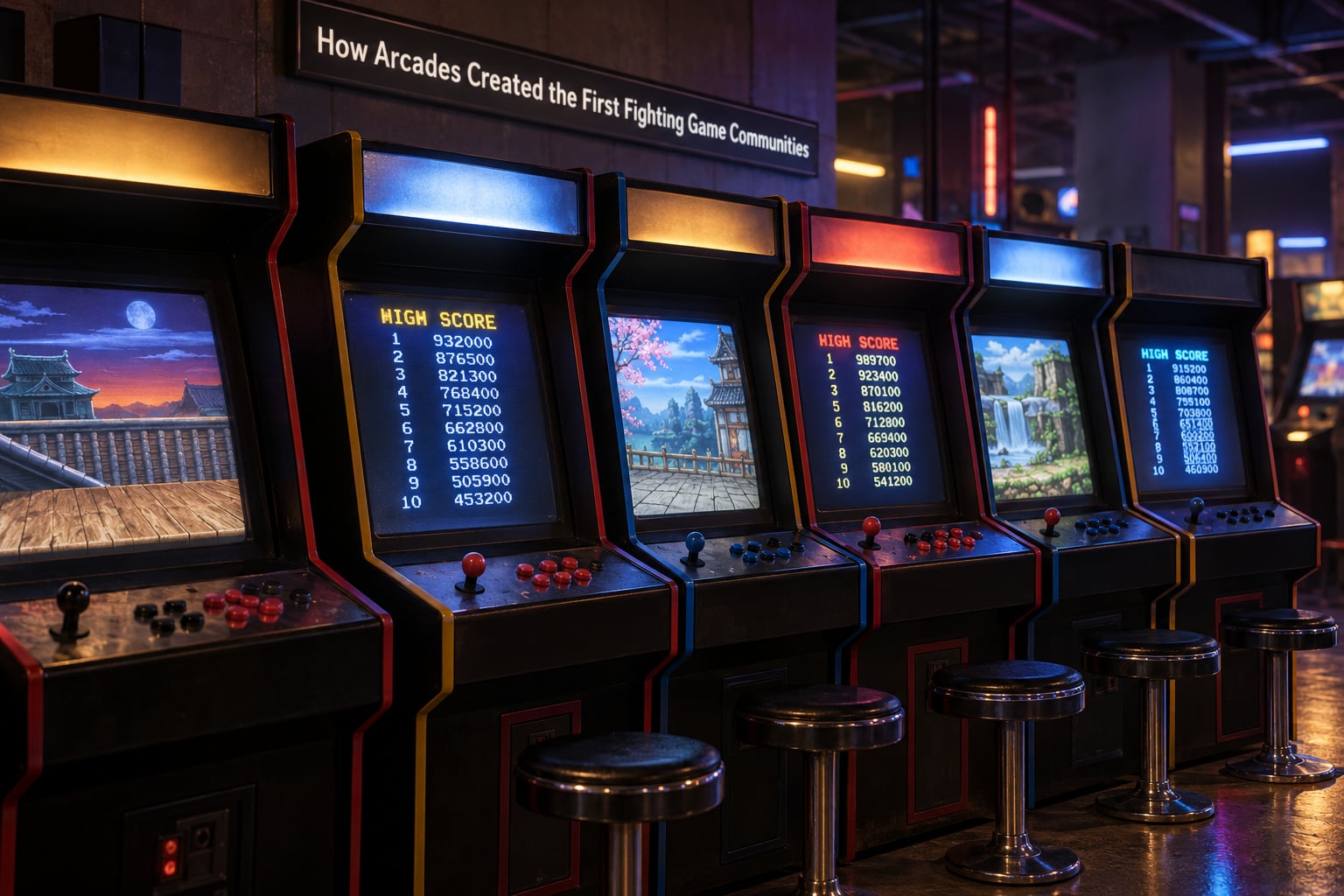
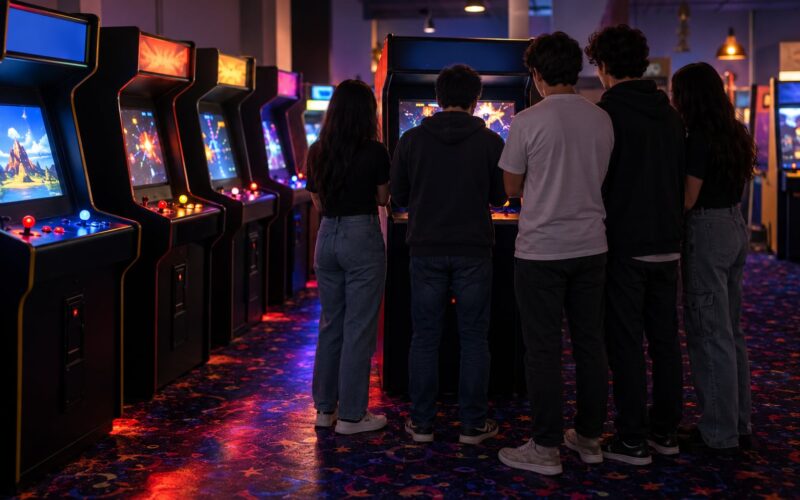
The arcade floor was the first scene infrastructure, and it worked because it solved the problem of finding opponents. Before the internet, if you wanted someone good to play, you had to physically travel to where the good players already were, usually on a specific night, and wait your turn.
What happened on that floor was closer to a seminar than a game session. A new player watched the strongest person in the place for fifteen minutes. They saw which moves got punished and which got blocked. They saw the crowd react to a perfect parry, which told them that perfect parries mattered, which told them something about what to practice. Nobody explained this. It was observed and absorbed, and the game was fresh enough that almost nobody had a shortcut.
Venues built identity around their cabinets. A place that owned a rare import board had a reputation that would follow it for years. The West Coast arcade scene in the 1990s ran through venues like the Golfland arcade in San Jose, and tournaments like Battle by the Bay in 1996 grew directly out of that floor rather than out of a corporate program.
Arcades also imposed a hard limit that shaped everything: whoever got there first got the machine, and once the line of people waiting behind them formed, the culture became about the queue. Newcomers learned to wait, then to talk to whoever was in line. That is where rivalries started, and rivalries are what keep a player coming back.
When the arcade floor eventually thinned out, the same people who had cut their teeth there took their habits elsewhere. The practice loop, the loser-buys, the sitting around between sets, and the casual-first attitude all transferred from the cabinet row to the game store counter with almost no translation needed.
How Local Tournaments Turned Participation Into Culture
A local, or locals as people usually say it, is a recurring tournament with an open bracket where anyone can sign up. That is the whole definition, and it is why the format is so good at building community: the entry cost is a small fee and the barrier is showing up.
The format did real cultural work. Somebody decided on a ruleset, usually a version of anything-goes with no banned characters and no fault-based restarts, and that decision alone made the event feel like the players’ own event rather than the publisher’s. Then somebody started a stream or a video, uploaded the matches, and the room got bigger on the internet than it ever was in the building.
The loop people describe over and over is that players become organizers. You show up to a local, you make friends, you get better, and eventually someone asks you to help run the next one. If you are the person most likely to say yes, you end up owning the event. The current version of the scene is standing on the unpaid labor of people who once sat in the same chairs as everyone else.
What an organizer actually handles in a week
Running a monthly local is a part-time operations job done by someone who also has a day job. Nothing about this is glamorous and all of it has to happen.
| Task | What it involves | Failure mode if skipped |
|---|---|---|
| Venue booking | Confirming the room, the power, the setup time and teardown time, and what the place allows | Event gets bumped for a private party |
| Hardware | Bringing consoles, adapters, controllers, spare cables, and a way to reset between sets | Input lag arguments mid-bracket |
| Bracket | Setting up an open bracket on a free tool, seeding, and handling check-ins | People wait in line not knowing if they are on deck |
| Rules communication | Publishing the ruleset before the event and repeating it at the start | Two-hour argument about a character ban after Top 8 |
| Content | Streaming, recording, cutting, and uploading matches and the Top 8 | Nobody outside the room ever learns the scene exists |
| Community upkeep | Answering the Discord, posting the next date, welcoming the first-timers | The same fifteen people show up and the scene slowly dies |
The pattern that works is boring consistency. A monthly event on the same day of the month, at the same place, is worth more than a big annual one nobody can plan around.
How Community Knowledge Was Passed Player to Player
The defining social habit of the FGC is that nobody hoards information. If you learn a matchup, the expected outcome is that you write it down where other people can find it. Matchup guides on community wikis like SuperCombo, long forum threads debating character tech, and Discord channels full of frame data and setups all come from this.
Before any of that existed, knowledge moved in person and by reputation. The strong player set the character they main, and everyone who wanted to beat them had to learn that character. In practice this meant that the scene had a shared vocabulary built out of whatever the top players used, and that vocabulary spread without anyone organizing it.
Casual play does most of the teaching work. Someone new walks in, gets bodied for a few sets, and one of the regulars says something like just pick up this character, this is the easiest matchup right now. That single sentence saves weeks. The teaching is informal, immediate, and tied to a real person who can watch your mistakes.
Online changed the ratio here more than anything else. A community wiki written in 2009 is still online now, and someone new can read the same matchup notes a top player used fifteen years ago. Long-lived community knowledge in the FGC is unusually well documented for a genre with this small an audience.
How Fighting Games Built Scenes Online
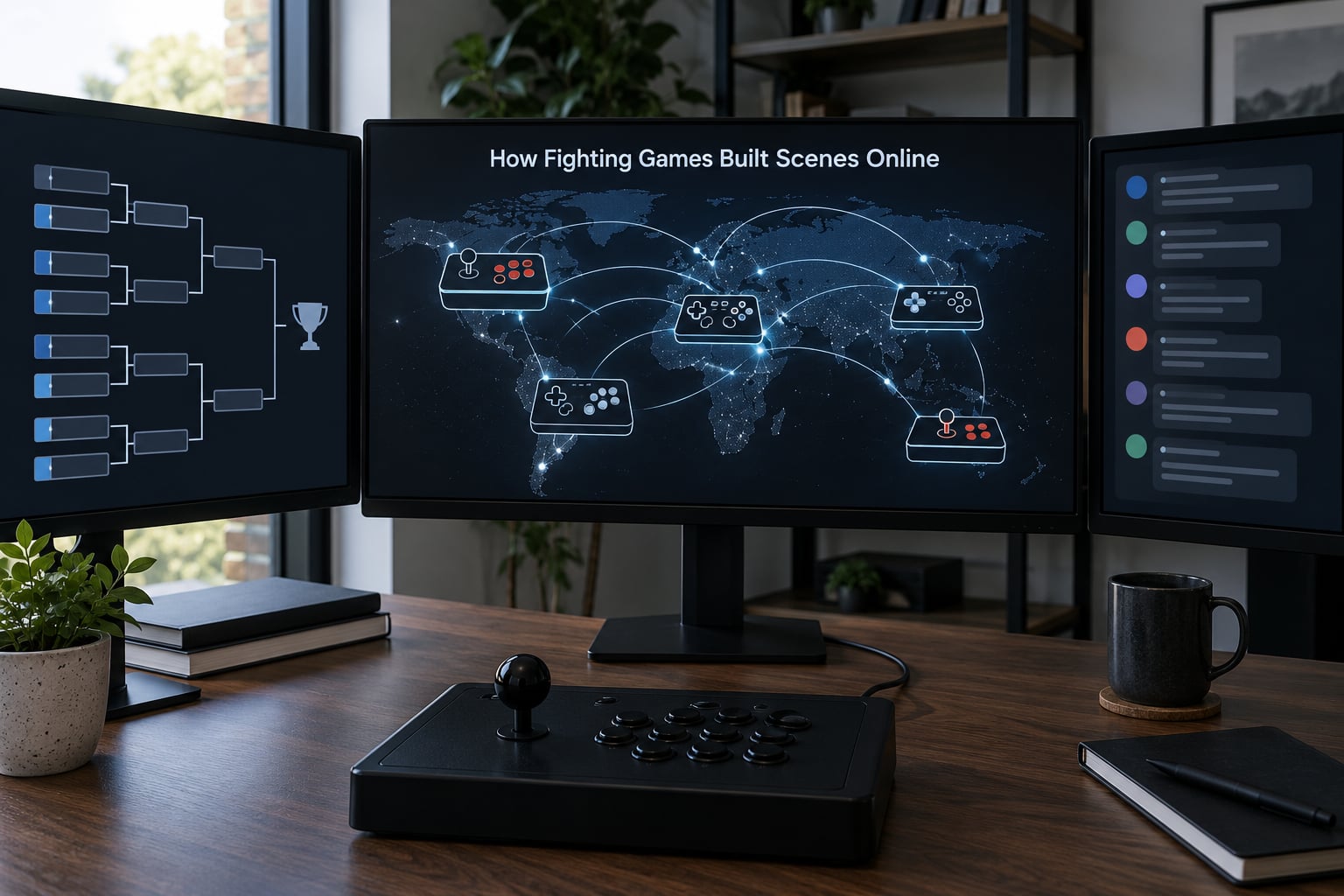
The internet let players who had never met share the same matchup notes on the same day. SuperCombo and the Shoryuken forums became the places where matchup theory got written down, argued over, and corrected after every patch.
Three tools did most of the heavy lifting for scene-building. Community wikis gave scenes a memory. Discord gave scenes a place to talk between events, which is what turns a monthly tournament into an actual community. And free bracket platforms like start.gg and Challonge let a single person with a laptop run a legitimate open bracket with no budget at all, which is what made small and regional events possible.
Then the netcode changed what a community could be. Rollback netcode, which sends inputs back and forth so the game can correct small delays, made online play feel like local play in ways that older online fighting games never managed. That single technical change let people who lived four hours away attend the same event, and it let a city with no serious scene compete with a city that had one.
The cost is fragmentation. Forum veterans describe the modern information problem clearly: multiple Discords, Facebook groups, accounts, and calendars, with no single source of truth. A person looking for events today can easily find three answers to a simple question about what is running next week. Regional community websites are the fix people keep proposing, and a lot of scenes now run one on a free static host because the alternative is a calendar nobody maintains.
There is a long-running joke that the player who makes a scene from zero is the player who starts a website, posts in the big communities, and streams the first events nobody attends. Small studios releasing new fighting games with no legacy audience depend on exactly this behavior. A new title has to be brought into the world by people willing to teach it, and the ones that succeed usually succeeded because somebody organized locals before the game had any following at all.
How Tournaments and Competitive Events Scaled the Scene
The scale-up from a shop counter to an international event took years and followed a predictable path: small events build players, players build a reputation, and a reputation attracts sponsorship and broadcast attention.
Battle by the Bay in 1996 was a West Coast Street Fighter tournament with a humble origin, and it grew into the event now known as EVO. Tougeki in Japan began as a national arcade fighting game tournament announced by a magazine in 2003. Super Battle Opera became the anchor event of the Japanese scene. These were community-driven events first, with organizers and staff who were not being paid by any publisher to run them.
The milestones below are the moments where that grassroots structure became visible to the wider world.
| Year | Milestone | Why it mattered for scene building |
|---|---|---|
| 1991 | Street Fighter II releases in arcades | Gave the genre a competitive depth that made standing next to a strong player worth doing |
| 1996 | Battle by the Bay, West Coast | First major community-organized event; proved locals could scale into a national draw |
| Late 1990s to early 2000s | SuperCombo wiki and the Shoryuken forums | Gave scenes a shared written memory that survived patches, migrations and new games |
| 2003 | Tougeki announced in Japan | Showed a magazine-organized national event could anchor an entire national scene |
| 2008 | Street Fighter IV releases | Pulled lapsed players and lapsed locals back into the genre at once |
| 2010s | Discord, free bracket tools, and VOD channels | Cut the cost of running and finding an event to near zero for a volunteer |
| 2010s onward | Rollback netcode adoption | Made online play good enough that geography stopped being the main barrier to competing |
Regional scenes stayed distinct, and the rivalries are still legible today. In the US the split between West Coast and East Coast shaped playstyles and storylines for decades. In Japan, regional identities like Kanto and Kansai carried their own prestige. In the King of Fighters world, national pride between Japan, Korea and China became part of how the scene was talked about, with dedicated tournaments built around those matchups rather than around publisher preference.
| Region | Anchor events | How the scene sustained itself |
|---|---|---|
| US West Coast | Battle by the Bay, later EVO | Dense arcade and store network feeding players into one large regional pool |
| US East Coast | Regional majors and long-running store locals | Strong local competition plus the console and PC crossover audience |
| Japan | Tougeki, Super Battle Opera | Arcade culture, magazine-organized national events, and shop-based play |
| Korea | Regional and national King of Fighters events | A highly competitive national circuit feeding international tournaments |
| Latin America | Regional majors and online weekly events | Fewer venues, so online play and regional travel do more of the work |
Scaling is where the volunteer model gets tested. A regional or international event needs a venue, hardware, staff, a broadcast setup, a ruleset nobody can dispute, and money for prize pools. Sponsors eventually arrive, but they show up after the crowd exists, and they do not replace the organizer who booked the room.
How Original Series Made Community Culture Visible
For most of the genre’s life, the scene’s history lived in the heads of the people in it. Then documentaries, original video series, interview features and player-produced archives turned that private memory into public record.
Long-form interview pieces with scene elders turned out to be the most useful format. A single organizer explaining how he built a national tournament from a private event, in his own words, does more to explain how these communities work than any summary of tournament rules. Translated arcade magazine interviews are the same idea in print, and the archive of them is where most written fighting game history actually comes from.
Video archives serve the same purpose for competitive moments. Old tournament footage is now permanently available, which means a new player can watch how a matchup used to look at a level nobody could compete at today. That footage is also the strongest recruiting material the genre has, because it shows the skill ceiling honestly instead of describing it.
The practical effect is that a new game’s marketing borrows the weight of a scene with thirty years of documented history behind it. That only works because somebody recorded the history in the first place.
How Publishers and Tournament Organizers Supported Grassroots Scenes
Official support in the FGC is real now, and it is worth being precise about what it does and does not do. Prize pools, sponsorship of larger events, netcode investment, and licensed tournament rulebooks all help. None of them build a scene in a city with forty players.
The sequence tends to be the same. Players build a scene around a release, the scene proves it has a real audience, and then publishers take an interest. Order matters. When support arrives before the community work, there is usually nothing local for it to attach to.
Rollback netcode is the clearest example of official investment paying off at the grassroots level. A publisher choosing to delay a release to improve netcode gave every small online scene a better chance of existing, and those small online scenes are what many current locals are built from.
There is a permanent argument inside the community about how much the publishers should do, and reasonable people land in different places. What nearly everyone agrees on is that the load-bearing work is still volunteer work, and that a scene which loses its organizer usually loses its calendar within a few months. Burnout is the quiet failure mode of grassroots scene building, and it is the thing that most needs solving.
What Fighting Game Communities Built That Lasted
Surviving a bad release cycle is what makes the FGC notable, and the genre has survived several. What the players built along the way outlasted most individual games.
Real player expertise. Deep matchup knowledge that gets written down and stays written down. A new player can read a fifteen-year-old matchup guide and find it still useful, because the community treats knowledge as something owed to the next person rather than something owned.
Local institutions. Recurring events on a fixed calendar, with a place players expect to see each other. People describe the small-school effect honestly: in a scene this size, everybody knows everybody, so bad behavior travels faster than in a large anonymous community. That cuts both ways. It is why the FGC is often described as self-policing, and also why a single organizer or a single loud regular can damage a scene badly.
Accessible online spaces. Discord servers, wikis, and free bracket tools that cost nothing to run and put a scene within reach of anyone with a controller and an internet connection.
Event traditions. Casuals before brackets. Loser buys. Everyone stays for Top 8. These rules are unwritten in most scenes and they are what make a tournament feel like a room full of people rather than a competition with spectators in it.
Pathways. The scene gives players something to do at every level, from someone who shows up to watch to someone who runs a venue, and it moves people between those roles without anyone assigning it. That is how an unpaid volunteer job gets filled in the first place.
Frequently Asked Questions
What is a fighting game scene?
A fighting game scene is the social structure around a competitive fighter: the players who show up, the venue, the tournaments someone volunteers to run, the places matchups get discussed, and the rivalries that form over time. A scene can exist around a brand new indie game with no history, or around a decades-old arcade title. The term covers both, because what defines it is the people and the regular events, not the publisher.
Did fighting games become popular only after esports existed?
No. Fighting game communities were fully formed decades before esports was a category. The arcade scene ran on Street Fighter II in the early 1990s, community wikis and forums carried matchup theory in the 2000s, and Battle by the Bay started in 1996 as a player-organized event. Esports later formalized and professionalized part of a culture that players had already built on their own.
How did players learn matchups before official guides?
They watched strong players, then wrote the information down themselves. On the arcade floor, newcomers observed what the best person in the room did and what the crowd reacted to. Later, community wikis like SuperCombo and the Shoryuken forums turned that observation into written matchup guides and frame data. Nobody withheld it, which is still the defining habit of the community.
What made local arcade tournaments important to the genre?
Locals solved the problem of finding opponents before the internet existed, and they gave players a reason to keep showing up. A recurring open bracket turned a game into a social activity, and the room around the brackets produced the friendships and rivalries that hold a scene together. Many of today’s volunteers learned to organize events by watching and eventually helping run these early tournaments.
How did online play change fighting game communities?
Online play removed geography as the main barrier to competing and dropped the cost of running an event to near zero. Free bracket platforms let one volunteer produce a legitimate open tournament, Discord kept players talking between events, and rollback netcode made online matches feel close to local play. It also created a new problem: information is now scattered across several Discords, groups and calendars.
Can a new fighting game scene still be built from grassroots communities?
Yes, and it is the normal case for small studios. A new title with no legacy audience gets its scene from people willing to teach it, post about it, and run locals before anyone is asking for them. Small and indie fighting games routinely build scenes this way, one persistent organizer and a monthly event at a time. The gap the community fills is player-to-player knowledge, which no publisher ships.
Conclusion: Start With the People Around the Game
The lasting lesson of how fighting game communities built their own scenes is that the infrastructure was always the community’s work, and the companies arrived later to support something players had already constructed. Arcades gave the genre a place to learn, locals gave it a calendar, wikis and forums gave it a memory, and rollback netcode gave it reach.
If you want in, the first step is small and concrete. Find the recurring local or online event your region runs, go twice before you compete, and talk to whoever is standing near you. Show up a third time and volunteer for something small. That is how every scene described here was built, one person deciding to do it themselves.