Arcade culture gave competitive gaming its scorekeeping habit, its head-to-head versus formats, its tournament infrastructure and its unwritten rules. That is how arcade culture shaped competitive gaming: the coin-op floor was the only place where skill could be measured in public, watched up close, and put on the line before leagues, streams or prize pools existed.
Most of what people call esports culture is a set of arcade habits that outlived the cabinets. Knowing a game inside out, standing in a queue without complaining, treating a loss as information rather than an insult, and gathering around a screen to watch someone better than you do the same thing you do every night. All of that started in a dim room full of coin slots.
Below is the version of the story that skips the nostalgia and looks at the mechanics. Which formats mattered, why the economics pushed competition off the floor, and which of those mechanics still show up in tournaments today.
Table of Contents
- How Arcade Culture Shaped Competitive Gaming
- Why Arcades Became the First Esports Venues
- From High Scores to Organized Competition
- What Early Arcade Games Taught Players About Competition
- How Tournaments Changed the Way Games Were Played
- Which Arcade Genres Helped Establish Modern Esports
- What Arcades Contributed to Modern Competitive Gaming
- Frequently Asked Questions
- Were video game tournaments really held in arcades?
- What was the first major arcade gaming competition?
- How did arcade games influence modern esports?
- Why were fighting games especially important to early esports?
- Did arcades have formal competitive rules?
- What separated an arcade gaming contest from ordinary high-score play?
- Conclusion
How Arcade Culture Shaped Competitive Gaming
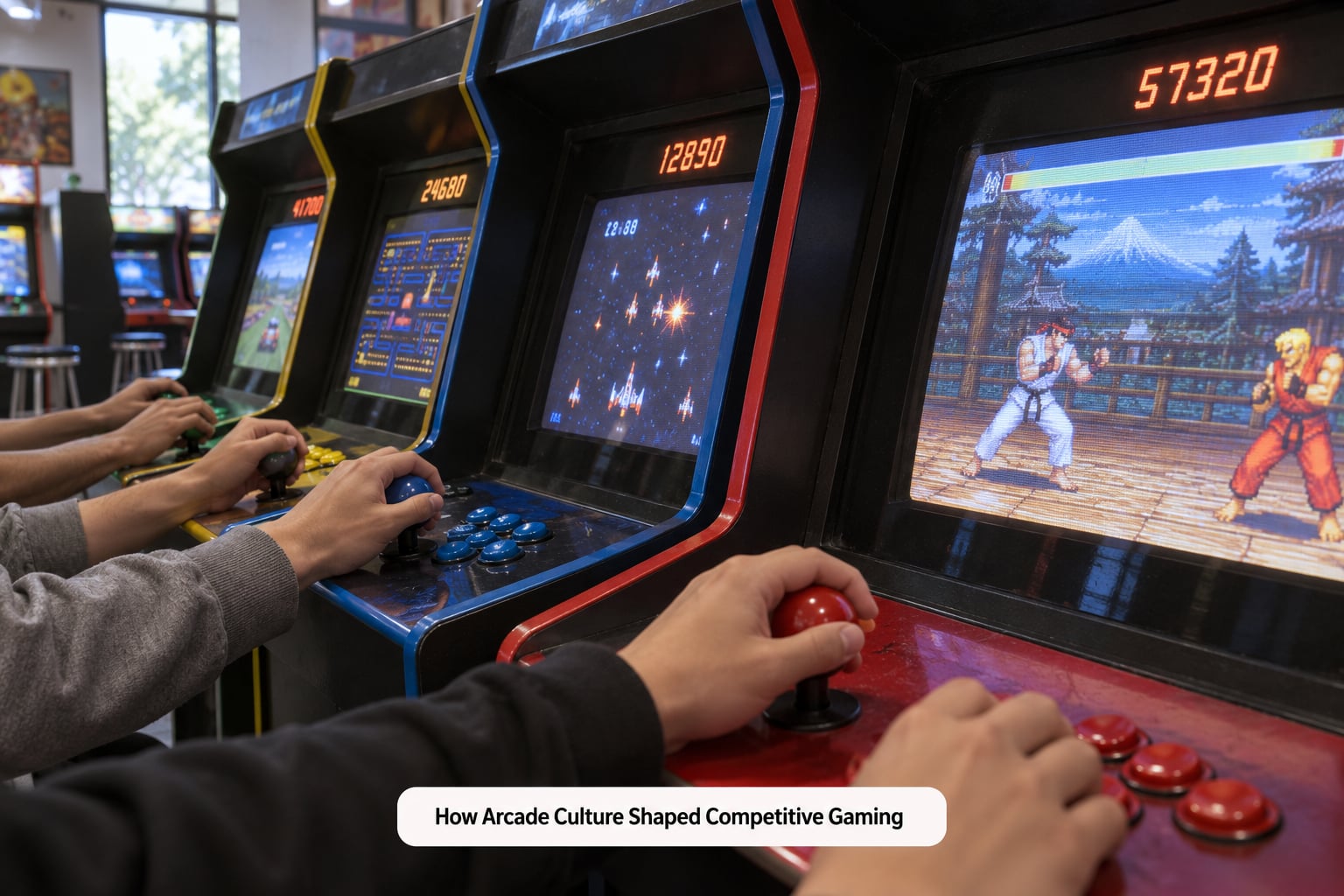
Arcade culture shaped competitive gaming through six things, and none of them were the games themselves. They were the room, the scoring, the hardware, the crowd, the tournaments and the rules.
- Public measurement. A high score on a machine was visible to everyone in the building. Skill stopped being a private matter the moment the cabinet started keeping score.
- Head-to-head defaults. Two controls, one screen, one shared set of stakes. Versus play was not an optional mode on most cabinets; it was the reason many of them existed.
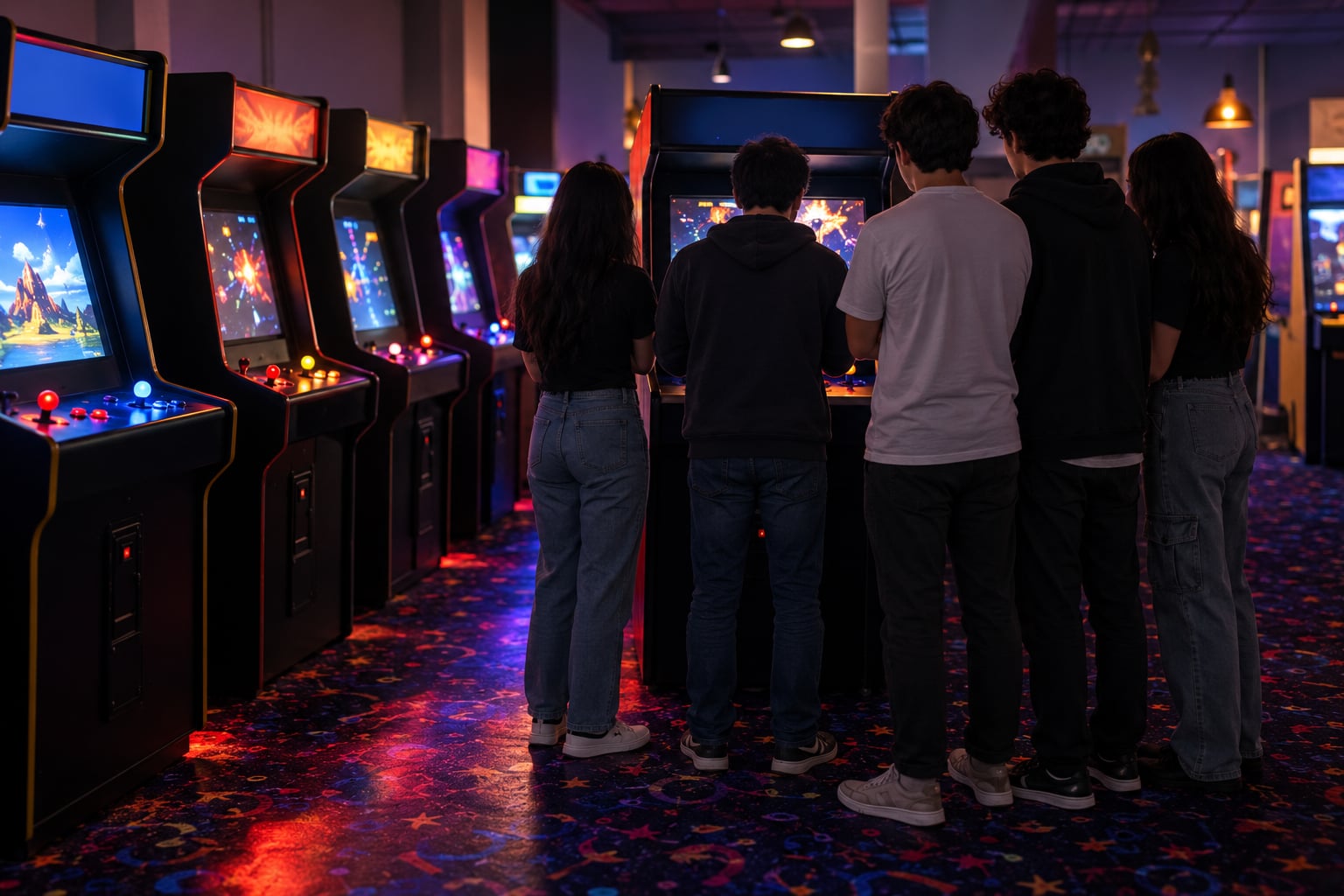
- Spectators as audience. A crowd around the cabinet amplified everything: the near miss, the comeback, the humiliation. Reaction was part of the experience.
- Dedicated hardware. Identical cabinets in every city meant identical conditions. That is the ancestor of match servers and standardized tournament setups.
- Prize tournaments. Cash and product contests turned a fun activity into something people travelled for.
- Informal rules. Waiting your turn, not hogging the machine, watching quietly. Nobody wrote these down, everybody enforced them.
The interesting part is that the arcade did not need a governing body, a broadcast deal or a sponsor. It just needed a room where the same game kept being played by different people, in front of each other, forever.
Why Arcades Became the First Esports Venues
Arcades were the first esports venues for one stubborn reason: nobody could afford the machine at home. A cabinet cost more than a used car, and the games came on chips that could not be copied. So the hardware had to live somewhere, and the somewhere turned out to be a strip-mall unit with a change machine and a carpet pattern that never showed dirt.
That economics had consequences for competitive play that people still feel. The good players were the ones who could get to the arcade. The arcade was the one with the cabinet that was hard on the third stage, or the cabinet where someone had just beaten Galaga, and towns usually had a handful of good rooms rather than one national scene. So competition was local, frequent and repeatable, in a way that internet play could not be for another two decades.
The room itself did more work than the games. Arcades were public amusement spaces with a social contract: you paid to play, you did not own the space, and the person at the cabinet had a claim on it until the game was over. Regulars built reputations the way players build handles now. A name attached to a score was status, and status in that room was social currency outside it too.
Scholars of the period make a similar point. Work published in Games and Culture treats the arcade as both a physical and a social space where conventions were negotiated rather than given, which is roughly why the culture transferred so cleanly to later competitive scenes.
From High Scores to Organized Competition
The first era of video game competition was not commercial and not in arcades. In 1972, students at Stanford wired two computers together and played Spacewar! between them, which meant the first documented video game tournament happened on university hardware at almost exactly the moment Pong was reaching the commercial arcades. It was small, it was recorded on a notes sheet, and it established the whole format: two players, a fixed rule set, a winner, a name written down.
The arcade era gave that idea a home. The 1980 Space Invaders Championship in California is usually treated as the first large public competition, and the key figure behind the record-keeping side of it was Walter Day, who ran the Aladdin’s Castle chain and insisted that records be witnessed, verified and documented. Day co-founded Twin Galaxies, which turned score chasing into something with paperwork and standing categories.
That paperwork mattered more than it looks. Once a score was a certified record rather than a boast, players had a reason to practise deliberately, study patterns, and defend a number instead of just chasing a bigger one. Guinness World Book of Records entries gave the activity a second, international layer.
The formats then matured in a recognisable order:
- Open score attack. Longest run, highest score, one player, one machine.
- Time-limited contests. A fixed clock on a fixed game, so two scores could be compared honestly.
- Head-to-head matches. Two players, alternating or simultaneous, decided in a set number of rounds.
- Elimination brackets. Losers go home, which creates the pressure modern brackets still rely on.
- Recurring events. A monthly tournament with a known champion, a public crowd and a scoreboard outside.
Each step moved the centre of gravity from the machine to the match. The scoreboard stopped being the point and started being the receipt.
What Early Arcade Games Taught Players About Competition
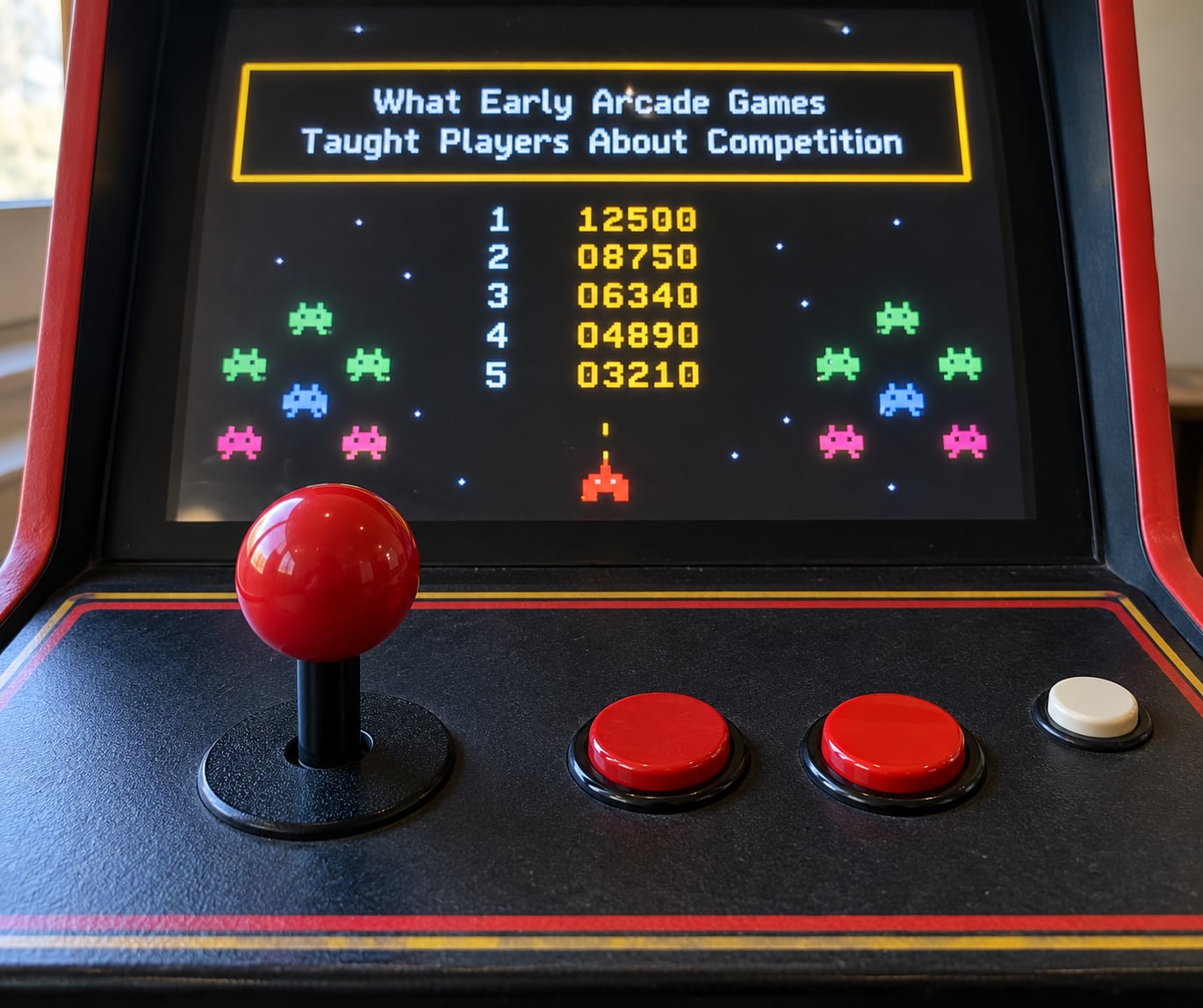
Arcade design is a tutorial in competitive habits, whether the designers intended it or not. A limited number of lives teaches resource management under pressure. Rising difficulty teaches that a safe lead is not the same as a won game. Short sessions teach commitment: you get a few minutes to prove something or you get nothing.
Clear win conditions are underrated as a training tool. Players always knew the objective, when it was met and who deserved the cabinet next. Compare that with an early console game where the goal was discovered by accident, and the reason many competitive players came from arcades rather than living rooms starts to make sense.
Risk-and-reward scoring pushed players toward optimal lines instead of safe ones, and several genres made execution the whole point. Shooting galleries demanded accuracy measured in fractions. Racing cabinets put a wheel or a trackball under your hands and turned smoothness into the skill. Multiplayer brawlers taught spacing and the value of a corner. None of these were generous to beginners, and all of them rewarded the player who put in off-hours that nobody could see.
Then the fighting games arrived and added the layer everything else was missing: matchup knowledge. Frame advantage, throw timing, safe jumps, character-specific routes. Street Fighter II in 1991 turned a cabinet into a classroom where two players publicly tested theories about each other, and the crowd could see who was right within a single round.
How Tournaments Changed the Way Games Were Played
A prize tournament changes behaviour before it changes anything else. With something on the line, players stop showing up to experiment and start showing up with a plan. They warm up. They practise specific characters. They watch opponents instead of playing, which is how the knowledge loop that defines the fighting game community really works.
Grassroots tournaments did three more things that matter for modern esports. They created local scenes with recognised names, so a player had a ladder to climb rather than a single room to haunt. They established bracket etiquette, including the loser who stays to watch, which is still the behaviour that separates a healthy tournament from a mess. And they made spectators normal, so the audience became part of the product rather than an accident.
Japan’s game centres pushed this furthest. Neo Geo’s hardware let a game run on dedicated arcade boards and on the same game at home on the same cartridge, which meant a local player could practise seriously and then walk into the same venue as everyone else without a hardware advantage. When Nintendo ran the Nintendo World Championships in 1990 with a competition cartridge and a modified grey NES, the console world was openly copying the arcade tournament model, rules and all.
By the 1990s, recurring events with printed brackets existed on three continents, and the pattern was fixed: local qualifier, regional bracket, national finals, a champion everybody can name.
Which Arcade Genres Helped Establish Modern Esports
Not every arcade genre produced a competitive discipline, but a few left direct descendants.
Fighting games gave the clearest line. Street Fighter II and Mortal Kombat made the versus match the main event, produced the crowd, the bracket and the vocabulary (matchup, side switch, bracket) that tournament organizers still use. Mortal Kombat added a layer of tournament history through the controversy over its finishing moves and the arcade versions that removed them.
Shooters supplied score tables and accuracy culture. Shmup and rail-shooter cabinets maintained public rankings of local experts for years, and the precision those games demanded is the same demand modern arena shooters place on a mouse.
Racing games contributed both wheels and, later, the first online competition. Daytona USA shipped with networked multiplayer in the arcade cabinet, which is a small technical footnote and a very large conceptual one: a coin-op game that could be played against a stranger far away.
Sports games offered accessible head-to-head formats with familiar rules, and they were frequently the first versus games a new arcade customer played. Light-gun games made accuracy a public spectacle. Beat-em-ups and platformers supplied local co-op traditions, which is where a lot of the early cabinet-to-cabinet play came from.
The genre that did not exist competitively is as telling: single-player story games with no score and no end condition. They sold plenty of cabinets and contributed almost nothing to competitive gaming, which tells you how much the format mattered.
What Arcades Contributed to Modern Competitive Gaming
The habits transfer better than the hardware ever did. Eight of them still run esports today:
- Public measurement. Ranked ladders, leaderboards and visible records are score tables with accounts attached.
- A fixed local scene. Every city still has a handful of venues where the serious players are known by reputation before they are known by handle.
- Standardised equipment. Arcade players showed up to a match on identical hardware. Tournament rules that restrict controllers, patches and settings do the same job.
- Queue and stage discipline. Waiting your turn, then getting off the machine, is why modern tournaments rotate players through stations on a clock.
- Spectatorship as default. The crowd gathered because watching was part of going, which is why arena seating and co-streaming are treated as essentials.
- Skill expressed through hardware feel. Players who cut their teeth on a stiff gate and a four-button panel still talk about sticks the way other players talk about monitors.
- Study in public. Labelling a matchup, character or timing window for the next person is an arcade habit that became a whole genre of community-made guides.
- Format first, story later. Competitive releases are built around head-to-head play from the start, because that is what the arcade floor demanded of every game it stocked.
| Element | Arcade era | Modern esports |
|---|---|---|
| Venue | Coin-op arcade or game centre | Lan hall, arena, online server |
| Entry cost | One coin per play | Tournament fee, subscription, or free ranked play |
| Format | Score attack or versus match | Bracket rounds, maps, sets |
| Scorekeeping | High-score table, witnessed records | Ranked ratings, official results, replays |
| Spectators | The crowd around the cabinet | Arena seats, co-streams, clips |
| Equipment | Identical cabinet in every city | Standardised tournament rules and settings |
| Skill expression | Execution, timing, matchup knowledge | Same three, plus team roles and prep |
| Session length | A few minutes per credit | Full match series, streamed for hours |
The arcade itself is still there too, though it changed shape. What many people now call a barcade, cabinets in bars and pubs, is closer to the old competitive room than the family entertainment centre that replaced it in the 1990s. Local fighting game meetups run the same tournaments the arcade tournaments ran, sometimes on the same hardware. The forum chatter about arcade nostalgia and the FGC points at the same thing: people miss the room, not the pins.
There is one thing the arcade could never provide, and it explains the whole industry that grew out of it. Nobody could practise. Every attempt cost another coin, every loss to a better player happened in public, and every drill had to be squeezed into a session you had paid for. That constraint is the single strongest reason competitive play moved to home hardware, then to LAN parties, then to the internet.
Frequently Asked Questions
Were video game tournaments really held in arcades?
Yes, for roughly a decade before console esports began. Arcades hosted recurring prize tournaments for shooting, racing, sports and early fighting games, usually run by the arcade operator or a local club. Rules were often informal at first: a fixed time limit, a score or a best-of series, and a champion recorded on paper. The audience stood close enough to see every input.
What was the first major arcade gaming competition?
The 1980 Space Invaders Championship in California is usually called the first large public arcade competition. It was organised by Walter Day, who insisted scores be witnessed and documented, a practice that led to Twin Galaxies and to Guinness recognition. An earlier and smaller event, a 1972 Spacewar! tournament at Stanford, predates arcades but ran on university hardware.
How did arcade games influence modern esports?
Arcades supplied almost every structure esports still uses: public scorekeeping, versus play on shared equipment, local scenes, tournament brackets, spectator crowds and unwritten etiquette about queues and machines. When formats moved to home consoles and LAN parties, they carried those habits with them. Modern differences are mostly scale: accounts instead of initials, servers instead of cabinets.
Why were fighting games especially important to early esports?
Fighting games made the match itself the event. A short, decisive format fit the coin economy, two-player cabinets put opponents across from each other, and matchup knowledge gave returning players a reason to study a game off-hours. Street Fighter II in 1991 also created the vocabulary of the fighting game community: bracket, side switch, safe jump, local and the crowd that watches both.
Did arcades have formal competitive rules?
Formal, written, standardised rules came later than arcade tournaments did. Early contests were usually organised by a shop manager or a small club: a time limit, a score target or a set number of rounds, settled in cash or product. Consistent formats arrived with the bigger circuits, when organisers needed identical brackets and identical equipment so results could be compared between venues.
What separated an arcade gaming contest from ordinary high-score play?
A contest opposed two people. High-score play measured one player against a number, and a contest measured two players against each other under a shared condition, usually a clock or a round limit. Records such as the witnessed high scores documented by Twin Galaxies belong to the second tradition; tournament brackets belong to the first. Both grew out of the same cabinets.
Conclusion
Arcade culture normalised gaming as a public, social, rule-bound activity. It made scores visible, made head-to-head play the default, gave spectators something to react to, and turned a room of strangers into a scene with a ladder you could climb.
If you want to see how arcade culture shaped competitive gaming in practice, start with a single match structure. Pick one fighting game, look at how a round is won and how a set is scored, then read how your local scene runs its weekly bracket. Everything modern esports added since kept that skeleton and scaled it up.